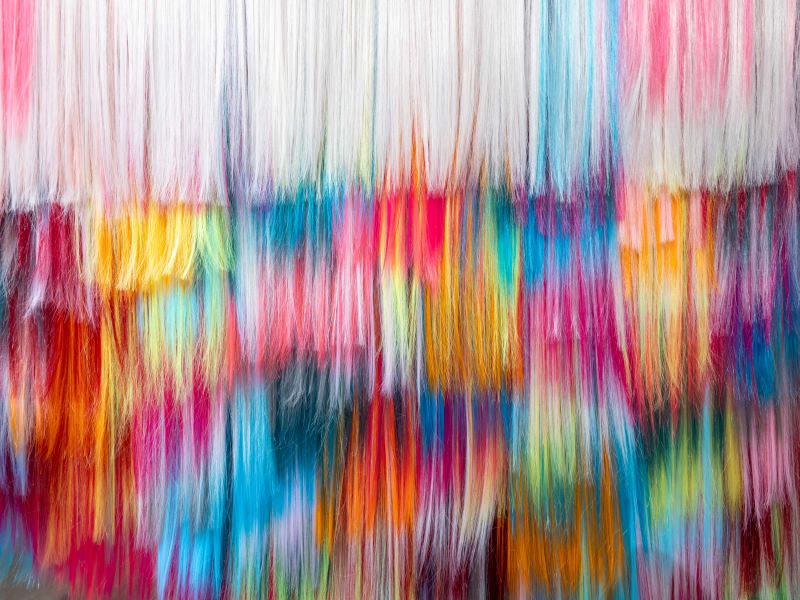
Sana Art is excited to present Hiva Alizadeh’s (b. 1989, Kerman) first solo exhibition in the Arab world. Singing in the Hanging Gardens of Babylon displays Alizadeh’s work from 2020 to 2025, offering audiences a chance to engage with the sculptural environments he creates from hair. In this show Alizadeh continues to explore the Persian miniature painting, particularly from the perspective of understanding it as a living visual language. Within this tradition, the garden is never merely a landscape but a mental and poetic space, suspended between reality and imagination, where time, narrative, and emotion coexist. Alizadeh continues this lineage by presenting an image of a garden, yet not on paper and not within the limits of two-dimensionality.
Alizadeh is a self-taught artist creating vibrant tapestries consisting of synthetic hair. While his practice plays homage to the millenary craft of Persian carpet weaving, it is also firmly situated within the nexus of contemporary art, placed within a number of philosophical and material dichotomies. As Alizadeh explores material and spatial questions through his work, he also occupies a relational space between painting and sculpture, thereby challenging the boundaries between the two.
This conceptual friction is at the core of his practice. For Alizadeh painting functions as the soul of the work, while sculpture provides a body through which that soul becomes visible. This in-between position is celebrated throughout his practice, resulting in fluid rather than resolved works of art. Methodologically Alizadeh works in an intuitive manner allowing the feeling to lead before the form appears. The choice of synthetic hair as a material emerged due to its capacity of holding emotional delicacy, intimacy, and movement. Hair allows Alizadeh to work with notions of memory, loss, and impermanence without fixing identity. Its tendency to fall, shift, and respond to gravity introduces time and change directly into the work.
In this exhibition, the spatial logic of the presented installation is informed by Persian miniature painting, where space is built through simultaneity and layering rather than linear perspective. The gates become sculptural forms, functioning as thresholds, invite visitors to enter the image. The human figure is absent, yet its presence is activated through visitors’ own bodies. Meaning emerges only through movement, proximity, and embodied experience.
Alizadeh’s work is part of several important public and private collections in Europe, the Middle East, China, and the USA including AkzoNobel Art Foundation in Amsterdam (the Netherlands), Palazzo Monti in Brescia (Italy), Frederick R. Weisman Art Foundation in Los Angeles (USA), Claus Busch Risvig Collection in Copenhagen (Denmark), Kerman Museum of Contemporary Art (Iran), and The Ned Doha Art Collection (Qatar). He has exhibited widely in Iran, Europe, and the US.
